
Yasyn Abdullaev is a Ph.D. Candidate in History at the University of California, Berkeley. His research deals with conspiracy theories and state politics in nineteenth-century Russia.
This post is part of a series dedicated to new research on the Decembrists and their legacy that appeared in a recent special issue of Canadian-American Slavic Studies 59.4 (2025) edited by Alexander Martin and Emily Wang: The Decembrist Bicentennial: New Perspectives on Russia in the 1820s. Work by Yasyn Abdullaev, Mikhail Belousov, Anna Nath, Stanislav Tarasov, and Ingrid Kleespies examines Decembrist emotional culture; the complications, legal and otherwise, of the interregnum that galvanized the Decembrists’ decision to act in December 1825; and the formation of the Third Department in response to the uprising. The introduction to this series of blog posts, by Ingrid Kleespies, may be found here. The previous posts in the series are here, here, and here.
The recent bicentennial of the Decembrist Uprising provides an opportunity to reassess the legacy of this historical event. Conspiracy theories are on the rise today, and not only among the “poor and uneducated.” Donald Trump promotes the “narcoterrorism” and “Deep State” narratives on the highest level; the European right widely appeals to anti-immigrant “Great Replacement” claims; and the Israel-Palestine conflict revived many popular Islamophobic (anti-Palestinian) and antisemitic tropes. Russia’s invasion of Ukraine, too, has been justified through conspiracy theories from the very start. Whether speaking of the “neo-Nazi clique” in Kyiv or NATO biolaboratories, Vladimir Putin sees this war as an apocalyptic battle against the “collective West.”
Conspiracy narratives do not exist in a vacuum. They reflect and shape the discursive and institutional structures of governments and media, influencing the distribution and direction of state power. The events that followed the Decembrist Uprising cemented the close bond between conspiracy thinking and the Russian bureaucratic mentality. The story of (post-)1825 is not so much about daring to oppose autocracy. It is a story of how autocracy used this daring as a pretext to legitimize further persecution and repression of real and perceived opponents.
Traditionally, we associate the Decembrist Uprising with the inception of the Russian revolutionary tradition. The notion of the “noble revolutionaries,” honorable in their democratic aspirations, yet “terribly far from the people” (Vladimir Lenin’s quote), was first formulated by Alexander Herzen. It was then further mythologized and ultimately incorporated into the Soviet pantheon of revolutionary heroes. The Decembrists served as an inspiration for future generations of freedom fighters, setting an example of self-sacrifice and unequal struggle against the autocratic tyranny.
The revolt itself, however, had the opposite consequence. Tsarist officialdom had been obsessed with secret societies since the late eighteenth century. The Southern European revolutions of the 1820s actualized these fears. The image of a coup d’état conducted by the Freemasons, Illuminati, or Carbonari took hold in the heads of Russian royals and leading officials. Tsar Alexander I (1801–1825) was seriously concerned that the conspirators from the “Parisian clubs” could appear on Russian soil. Against this background, the Decembrist Uprising was a bona fide conspiracy that confirmed the threat from malevolent secret societies.

After suppressing the revolt, the newly enthroned tsar, Nicholas I (1825–1855), began searching for answers: how could such a thing occur in Russia? Who was responsible? Could this happen again? During the official investigation and in informal conversations with foreign diplomats, Nicholas, together with his closest confidants, tried out several interpretations.
They eventually came up with a scenario that they proclaimed in the final report of the investigative commission and in royal manifestoes. The Decembrists, they wrote, were a bunch of overeducated youngsters who became too involved with “poisonous” Enlightenment ideas. They did not represent Russia’s true nature, and their bloody enterprise was doomed from the start. Luckily, “Holy Rus” was inhabited by loyal Orthodox Christians, making an anti-government plot from within impossible. If something were ever to take place, they continued, the underlying malice would have to emanate from abroad or from foreigners living in Russia.
Although the 1825 revolt demonstrated that home-brewed conspiracies against Russian autocracy existed in reality, Nicholas I declared that such conspiracies could only be foreign. Thus did the the meta-narrative of the “anti-Russian plot” come into being. As a state imperative, it made Russia’s moral supremacy a foundation of its sovereignty and integrity. As a conspiracy theory, it identified non-Russian “aliens” and liberal secret societies as archenemies striving to covertly ruin the empire.
The concept of the anti-Russian plot both mirrored and shaped reality around it. On the one hand, the idea of Russia’s insusceptibility to conspiracies stemmed from the relative political tranquility of Nicholas I’s reign. At the same time, influential imperial policymakers appealed to this narrative to further their interests. Their rhetoric determined the government policy in several crucial areas, especially the security apparatus.
The 1830 November Uprising in Poland reaffirmed the Russian imperial regime’s concerns. After the revolution’s defeat, thousands of Polish aristocrats, intellectuals, and officers emigrated to Western Europe. There, they formed patriotic associations aimed at restoring Polish independence. The administrators of the empire’s “western borderlands,” which comprised today’s Poland, Lithuania, Ukraine, and Belarus, often mentioned revolutionary emissaries plotting subversions in the region. While some of these plots, like the ones led, respectively, by Szymon Konarski in 1837 or Piotr Ściegienny in 1844, really existed, others were either exaggerated or purely fictionalized.

Whether a conspiracy was real or imagined, its invocation proved efficient in justifying the ruling elite’s decisions. The Viceroy of the Kingdom of Poland, Prince Ivan Paskevich, significantly expanded his dictatorial rule by referring to the constant reports of secret societies’ clandestine activities. He strengthened the local gendarme corps and subjected it to his authority, incorporated Polish schools into the imperial educational system, and tightened border control. His colleague, Ukrainian Governor-General Dmitrii Bibikov, described the “restless persecution” of secret societies as the main achievement of his 15-year term. Under the pretext of chasing out Konarski’s epigons from Ukraine, Bibikov expanded and Russified the ranks of the local police, replaced elected judges with an appointed judiciary, and put himself in charge of the region’s education.
Such examples abounded in the Russian Empire under Nicholas I. There were nuances, however. Not all top-ranking officials could instrumentalize conspiracy theories as effectively as Paskevich or Bibikov. Besides mastering conspiratorial rhetoric, bureaucrats needed the tsar’s favor, social clout, and the appropriate cultural and institutional environment to turn their arguments into actual policies.
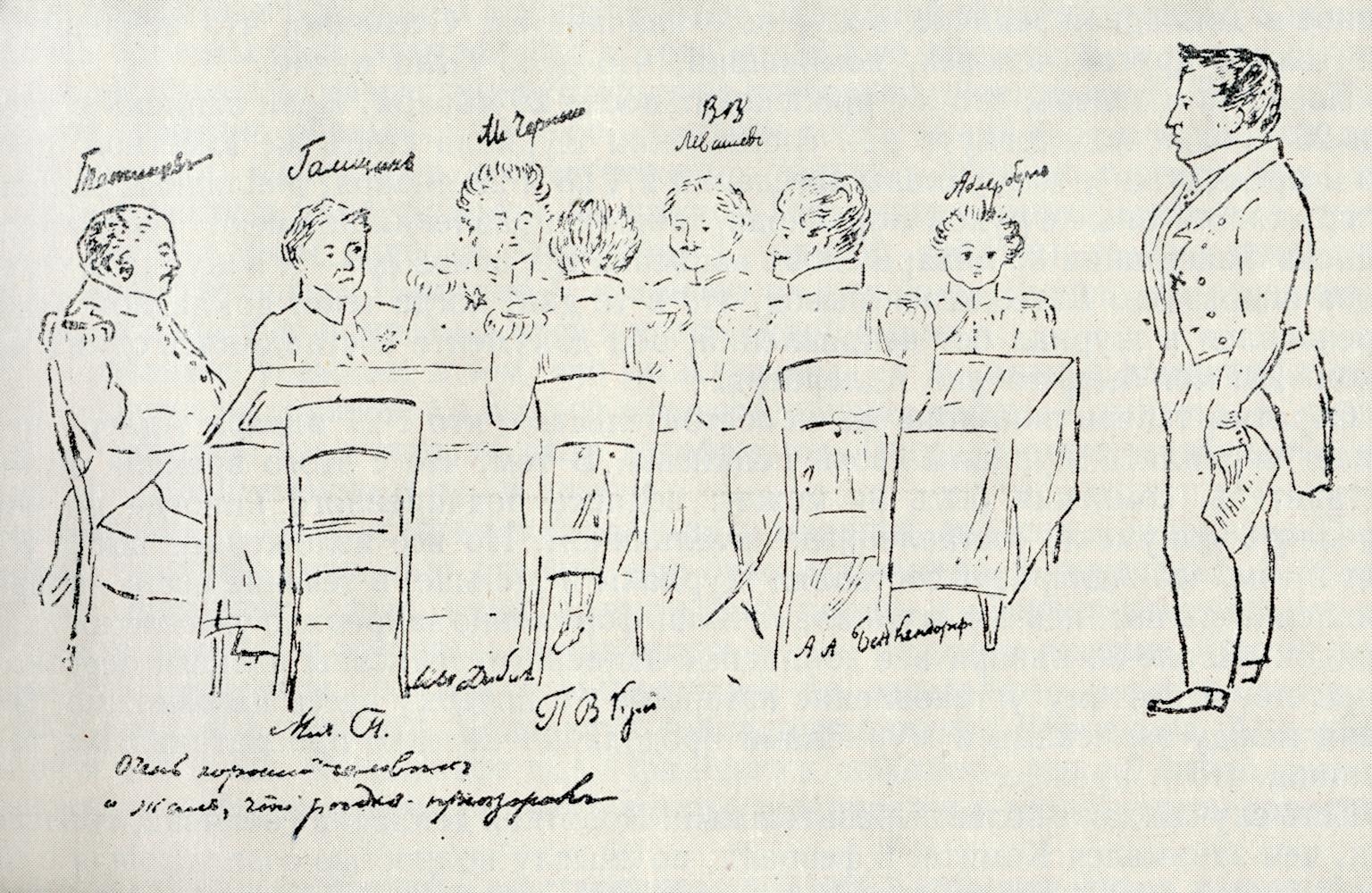
The establishment of Nicholas I’s secret police, the Third Section of His Imperial Majesty’s Own Chancellery, appears to be a perfect example of the post-Decembrist securitization. Created in 1826, its goal was to ferret out the remaining secret societies. Its chiefs and agents, however, downplayed the denunciations about plots brewing in the metropole. Instead of exaggerating such information to gain more resources, they emphasized the image of an incorruptible Russia. Dignitaries like Alexander Benckendorff, Alexei Orlov, and Leontii Dubbelt refused to portray Orthodox Russians as conspirators. Thus, in 1849, the Third Section opposed the Ministry of Internal Affairs, depicting the Petrashevsky Circle not as a dangerous conspiracy, but rather as a group of unruly youth.

An appeal to conspiracy theory thus constituted more than a cynical instrumentalization. These narratives guided people through the complexities of nineteenth-century politics, a world full of actual plots, be they the product of court scheming or underground insurgency. Rational interests and sincere beliefs do not exclude one another, especially in conspiracy theorizing.
In that sense, what we witness today is hard to reduce to pragmatism alone. For Putin and some of his cronies, such as Nikolai Patrushev, the idea of a struggle against the West’s perpetual intrigue is more than a smokescreen. It is a part of their raison d’être.
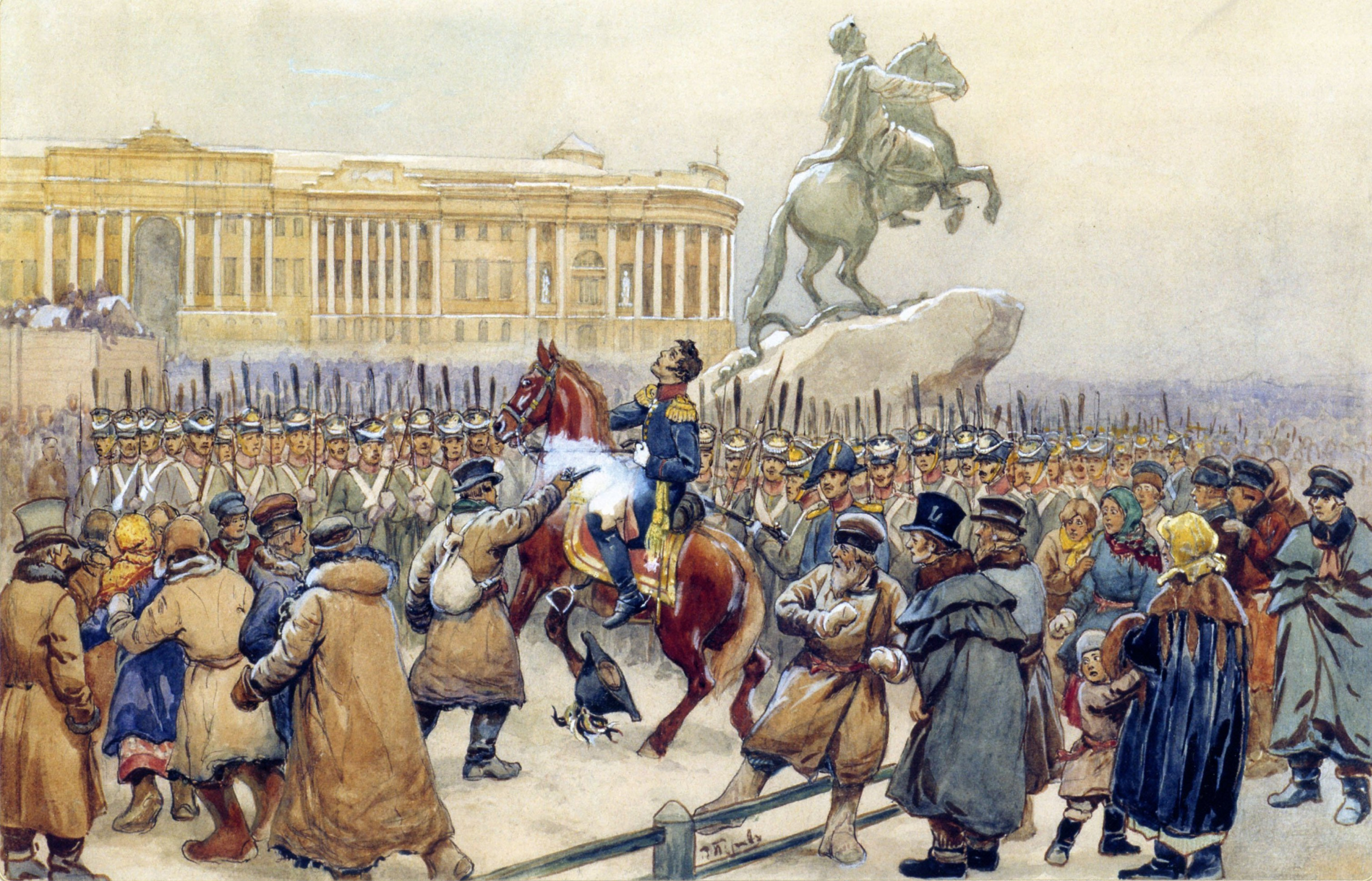
The Decembrist conspiracy was the conspiracy that prompted imperial authorities to act and legitimized their obsession with sinister Masonic and Illuminati schemes. To prevent another December 14, the government satisfied numerous demands for the expansion of its punitive apparatus. After the events on Senate Square, the wish to protect the state from underground conspirators appeared reasonable. The Decembrist Uprising enabled conspiracy-driven securitization, which continues to serve the purposes of the Russian autocratic state today.